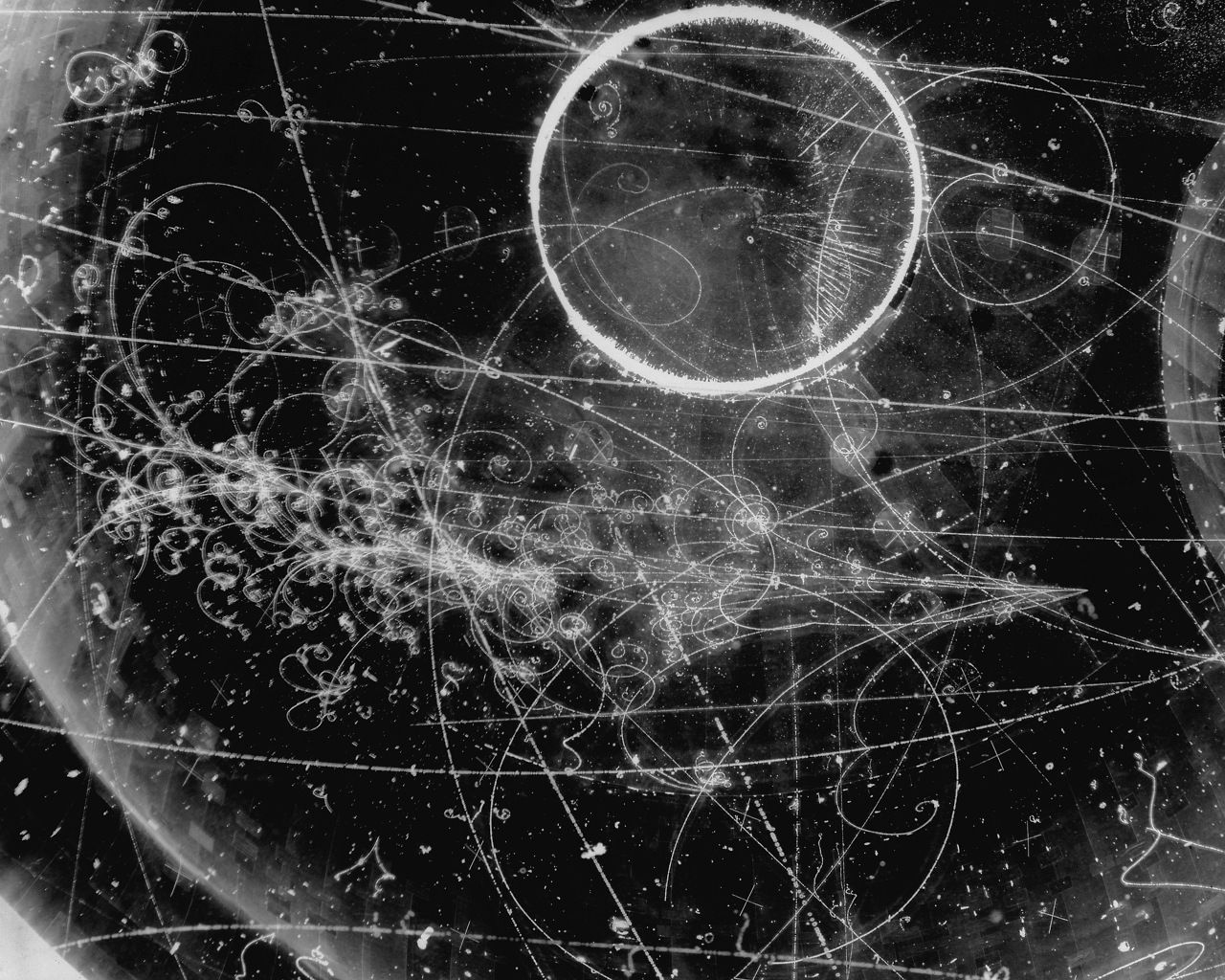
Ode To The Unseen
How strange the Physics of some particles are
Once again strikes Schrödinger's 'h-bar',
I often think of the scalar boson Higgs
Is the graviton really just a bunch of myths?
For decays, baryon number must be conserved
Yet parity and isospin can be ever so unpreserved,
Tau; a lepton and what kaons used to be called
When would the neutrino mass problem be solved?
We live in a real world, yet numbers can be magical
The standard model feels like a family, theatrical
Gluons bind quarks together, stronger than being taped
Did you know a nucleus could be pear-shaped?
Nowadays, particles can be ghostly or exotic
What if there were really Tachyons, so very quick?
Apparently 'barns' were popular, back in the 1940s
Oh to be slow as a UCN, live life chilled and at ease.
Discovery of the Top Quark
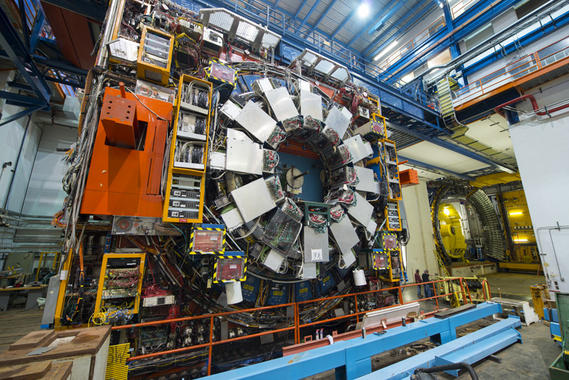
Fermi National Lab - Tevatron Circular Accelerator
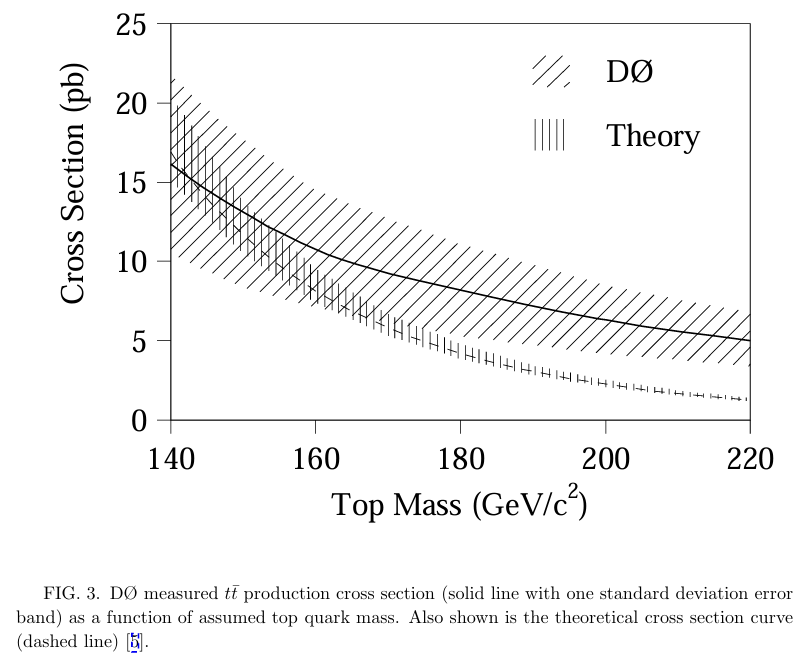
Observation of the Top Quark - DØ Experiment
References:
The Discovery of the Top Quark by Tony M. Liss & Paul L. Tipton
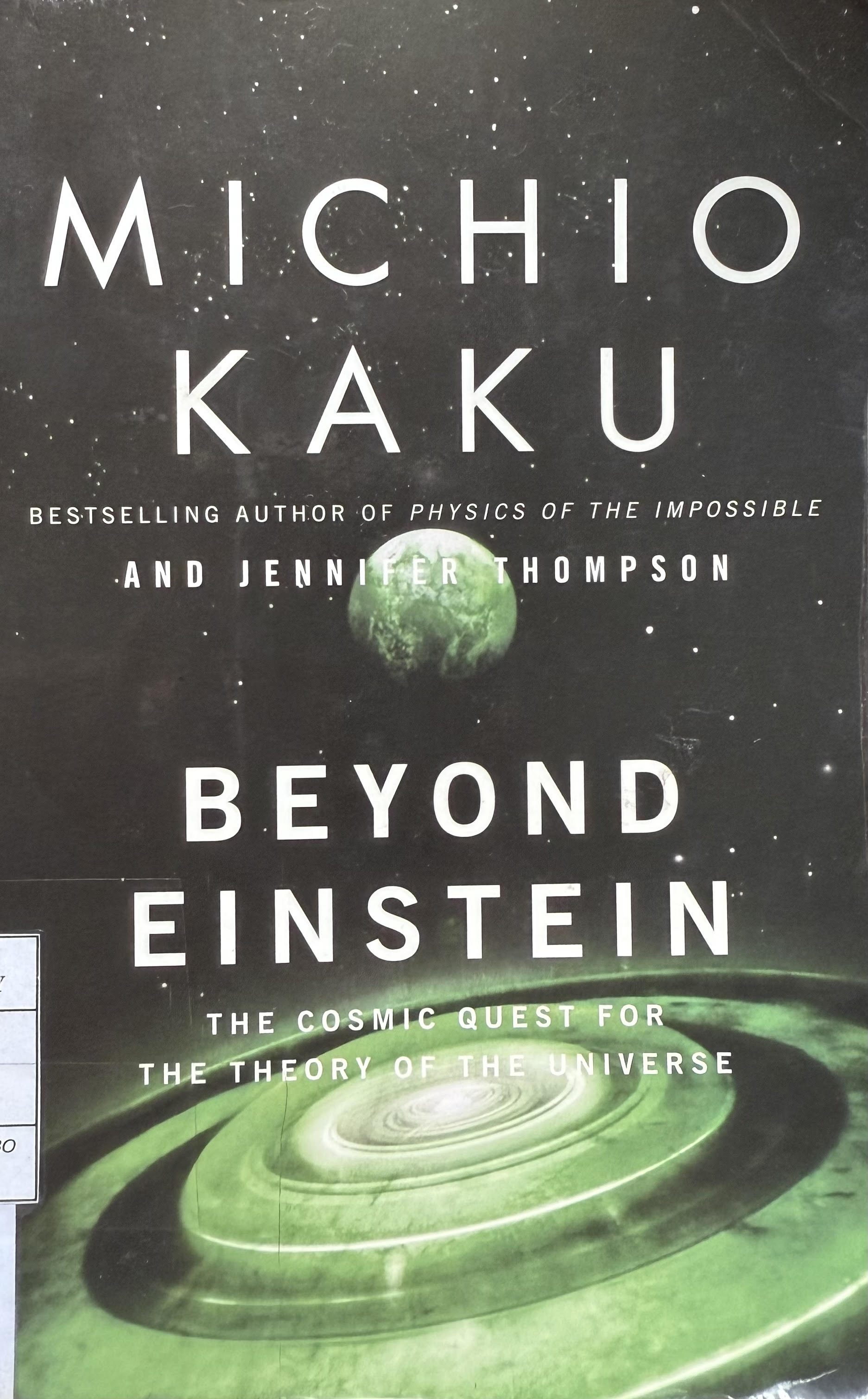
and 'Beyond Einstein' by Michio Kaku and Jennifer Thompson
Refer to them for more info on the discovery of the top quark! 😉
We know that quarks come in several pairs or generations.
The lowest pair are the up and down quark
(they are the lightest quarks and make up protons & neutrons).
The next heavier pair of quarks are the strange and charm quarks.
With the discovery of the bottom quark at Fermi Lab in 1977,
there just had to be a third generation,
with another quark (top quark) to form the pair.
Now it just needed to be found. Sounds simpler than it was!
The top quark, as it turns out, has a mass of about 175 GeV.
Thus, creating a top quark required concentrating a huge amount
of energy into a very miniscular region of space.
This was done by accelerating 2 particles (proton and antiproton)
and having them smash into each other, with the hope that at least
a few out of the trillion or so collisions would cause a top quark
to be created out of the energy from the impact.
By 1988, the top quark had not yet been observed at CERN,
with the conclusion being its mass had to be greater than 41 GeV,
and later that it had to also be greater than 77 GeV.
CERN having reached its limit, the competition was now between
CDF (Collider Detector at Fermilab) and DØ (D zero) of Fermilab.
By 1992, the top quark mass limit had reached 91 GeV,
and by 1993, it had reached 131 GeV.
In 1994, of the trillion or so collisions created within CDF,
12 events had been isolated that seemed to involve the creation
of a top-antitop pair.
Through a study involving the reconstructing of the top mass,
the mass was predicted to be clustered in a narrow range,
implying a top mass of about 175 GeV.
After the simultaneous submission of 2 research papers
by CDF and DØ on February 24, 1995,
and the final presentation of the finding, on March 2, 1995,
it showed overwhelming evidence for the top quark,
from both CDF and DØ, reporting a probability of less than
one in 500,000 that their top quark candidates could be
explained by background alone.
The top quark was at the time found to be 175.6 GeV in mass,
suggesting that it may be fundamentally different
from the other quarks.
What is Quark-Gluon Plasma?
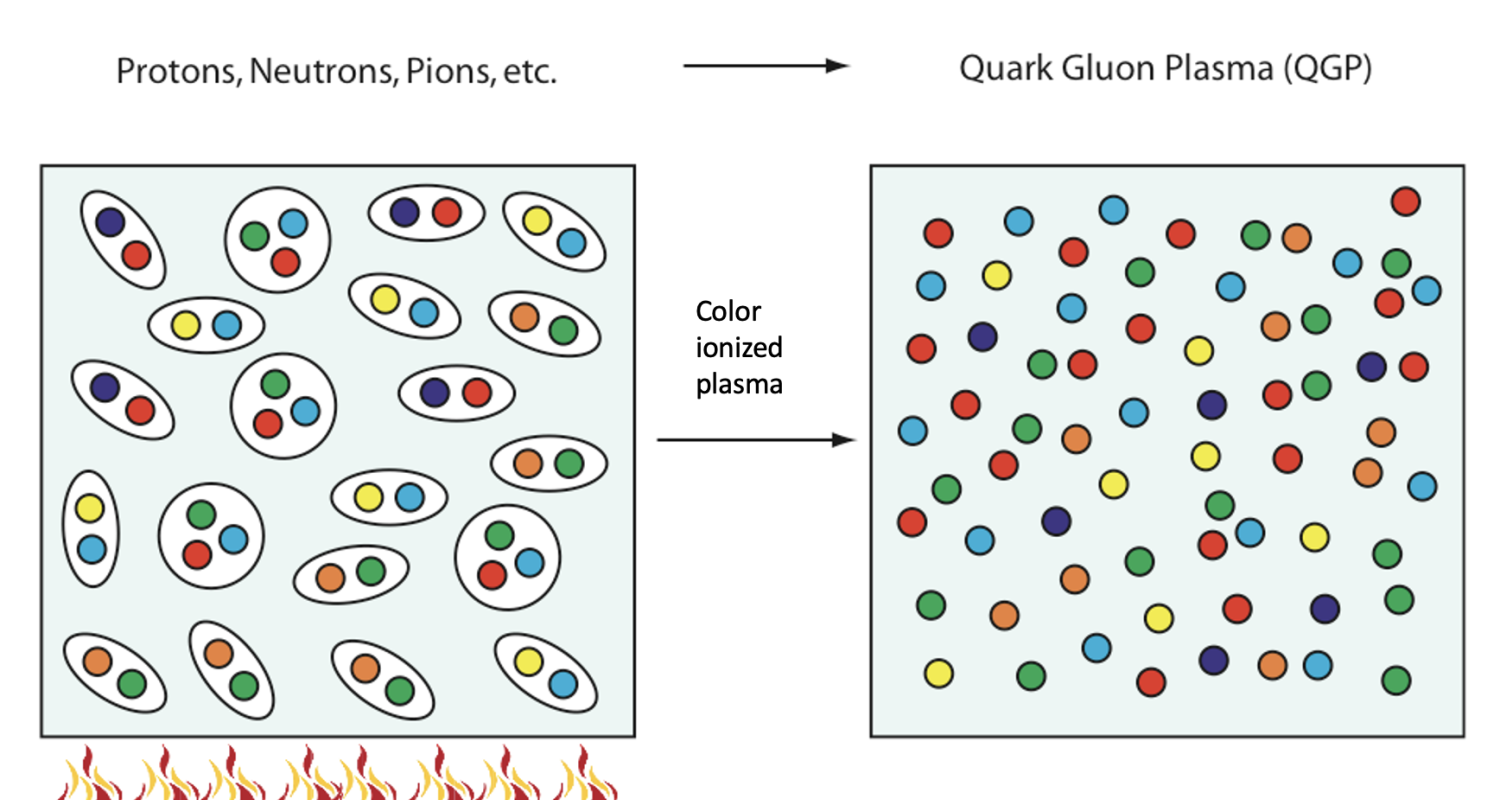
Hadrons are composites of quarks,
held together by gluons, which are the carriers of the strong force.
Under normal conditions, these quarks and gluons are confined
- they cannot exist freely, but are confined inside hadrons
(baryons and mesons like, protons, neutrons, and pions).
However, if we reach unimaginably high temperatures
- think a few trillions of Kelvins -
or when compressed to extremely high densities,
the hadrons lose their identity and dissolve into a soup of their constituents,
which are quarks and gluons.
It emerges at aymptotically high temperatures and low chemical potentials,
where the strong interaction becomes weakly coupled,
transitioning from hadrons to a plasma state.
 Berndt Müller, in his article 'What is the Quark-Gluon Plasma made of?'
This first conjecture was related to the realization that the candidate
non-Abelian field theory of inter-quark forces, QCD,
predicts their weakening at short distances,
as mentioned by Roman Pasechnik and Michal Šumbera.
Rolf Hagedorn noticed that as one heated hadronic matter,
the number of possible new particle states seemed to increase exponentially,
instead of the temperature continuing to increase.
It was the entropy that increased with the collision energy.
And as more and more energy was poured into the system,
new particles were produced.
Thus, there was a 'limiting' temperature that one couldn't go past.
This was what was connected with the second conjecture by Cabbibo and Parisi.
But both of these conjectures are only partially correct.
Because it is wrong to think that quarks and gluons are almost free in QGP.
Instead, there is a strong interaction between quarks and gluons in QGP,
that the term 'strongly coupled quark-gluon plasma' is now usually in use.
References:
Phenomenological Review on Quark-Gluon Plasma:
Concepts vs. Observations
by Roman Pasechnik and Michal Šumbera
What is the Quark-Gluon Plasma made of?
by Berndt Müller
Quark Gluon Plasma - an overview
Heavy ions and quark-gluon plasma | CERN
Journey Through the Quark Gluon Plasma |
CMS Experiment
The Tale of the Hagedorn Temperature by Johann Rafelski and Torleif Ericson
ATLAS observes top quarks in lead-lead collisions | CERN
Probing the Time Structure of the Quark-Gluon Plasma with Top Quarks
Heavy-ion collisions at the Large Hadron Collider: A review of the results from Run 1 by Néstor Armesto & Enrico Scomparin
Shortly After the Big Bang
In those infinitesimal moments, the quarks and gluons were bound weakly, free to move on their own, in what's called a 'quark-gluon plasma'.
Recreating Conditions of Early Universe
In heavy-ion collisions, large atomic nuclei collide at very high speeds.
This creates extreme conditions like those present just after the Big Bang.
Heavy-Ion Collisions
Think about the many protons and neutrons in them.
Collisions with one another occur at energies of more than a few trillion electronvolts each.
Then a miniscule fireball forms, in which everything 'melts' into a QGP.
Lead-Lead Collisions
~ 82 protons
~ 126 neutrons.
Yup, that's right - Magic Numbers!
Extremely Short Lifetime
Therefore, it cannot be observed directly.
Study Particles like the Top Quark
Such particles are used as probes of QGP's properties.
Types of Probes
Slow (low momentum) particles from the bulk QGP fluid
2. Hard Probes:
Fast (high momentum) particles created at the beginning of the collision
What do Soft Probes Reveal?
~ How the fireball flows
~ Temperature at freeze-out
~ Size of the system
~ How many particles were created
Examples:
Total particle multiplicity, Flow ansiotropies, Femstoscopic radii, Particle ratios - hadrochemistry
What do Hard Probes Reveal?
~ Jet quenching - how much energy jets lose
~ How heavy quarks move in the QGP
~ Do quarkonium states survive or melt
Examples:
Jets and dijets, High-pT hadrons, Heavy-flavour D and B mesons, Quarkonia (J/ψ), Photons, W, Z bosons
Image Reference:
Journey Through the Quark Gluon Plasma | CMS Experiment
Click for more info!
What is the CP Problem?
CP Symmetry
+
Parity (flip left to right)
Violated in Weak Interactions
Examples:
~ Kaon decays
~ B-meson decays
But In Strong Interactions
The quark mass matrix also causes CP violation.
The 2 combined together gives a factor θ.
If θ ≠ 0, it would cause the neutron to have a permanent electron dipole moment (EDM).
Experimental Neutron EDM
Also θ ≲ 10−10.
The Problem
This implies that CP symmetry is conserved, instead of being violated!
What to Look for?
EDM & Spin
The neutron only has 1 vector that breaks Lorentz symmetry - its spin.
The EDM points in the same or opposite direction as the spin.
REFERENCES:
TASI Lectures on the Strong CP Problem and Axions by Anson Hook
Strong CP from a Hidden Chiral Condensate by Csaba Csáki, Samuel Homiller and Taewook Youn
What can solve the Strong CP problem? by David E. Kaplan, Tom Melia, and Surjeet Rajendran.
S-Matrix (Scattering-Matrix)
Michio Kaku and Jennifer Thompson, in their book 'Beyond Einstein',
defined the S-matrix as a term used to describe collisions
like electrons or atoms bumping into one another.
It is merely a set of numbers that contain all the information of what happens when particles collide.
It tells us how many particles will scatter at a certain angle with a certain amount of energy.
Calculating the S-matrix is profoundly important, because if the S-matrix were known completely,
in principle it would be possible to predict virtually all the properties of the material.
One importance of the S-matrix is that it can explain puzzling, everyday phenomena.
For example, physicists in the nineteenth century,
using a crude form of the S-matrix for the
scattering of sunlight in the air,
were able to explain for the first time why the sky was blue
and sunsets were red.
Similarly, when quantum physicists of the 1930s calculated the S-matrix for
colliding hydrogen and
oxygen atoms,
they could show that water would be created.
In fact, if we knew the S-matrix for all possible collisions between atoms,
in principle we could
predict the formation of all possible molecules,
including DNA molecules.
Ultimately, this means that the S-matrix holds the key to the origin of life itself.
Beyond Einstein - Michio Kaku & Jennifer Thompson